The Orkneyinga Saga gives one of the clearest narrative accounts of how Christianity was established in Orkney, presenting the change as a political and social process rather than a sudden spiritual awakening. The saga was written in Iceland in the early thirteenth century, drawing on earlier oral traditions and historical memory, and it treats the conversion as part of the wider relationship between the earls of Orkney and the kings of Norway.
According to the saga, Orkney in the late tenth century was ruled by Earl Sigurd the Stout, a powerful figure with strong ties to Norway. At this time the islands followed traditional pre-Christian religious practices, which were shared across much of the Norse world. The turning point came through the actions of King Olaf Tryggvason of Norway, who was actively promoting Christianity throughout his realm and beyond. The saga makes it clear that Olaf regarded the religious alignment of Orkney as a matter of royal authority as much as belief.
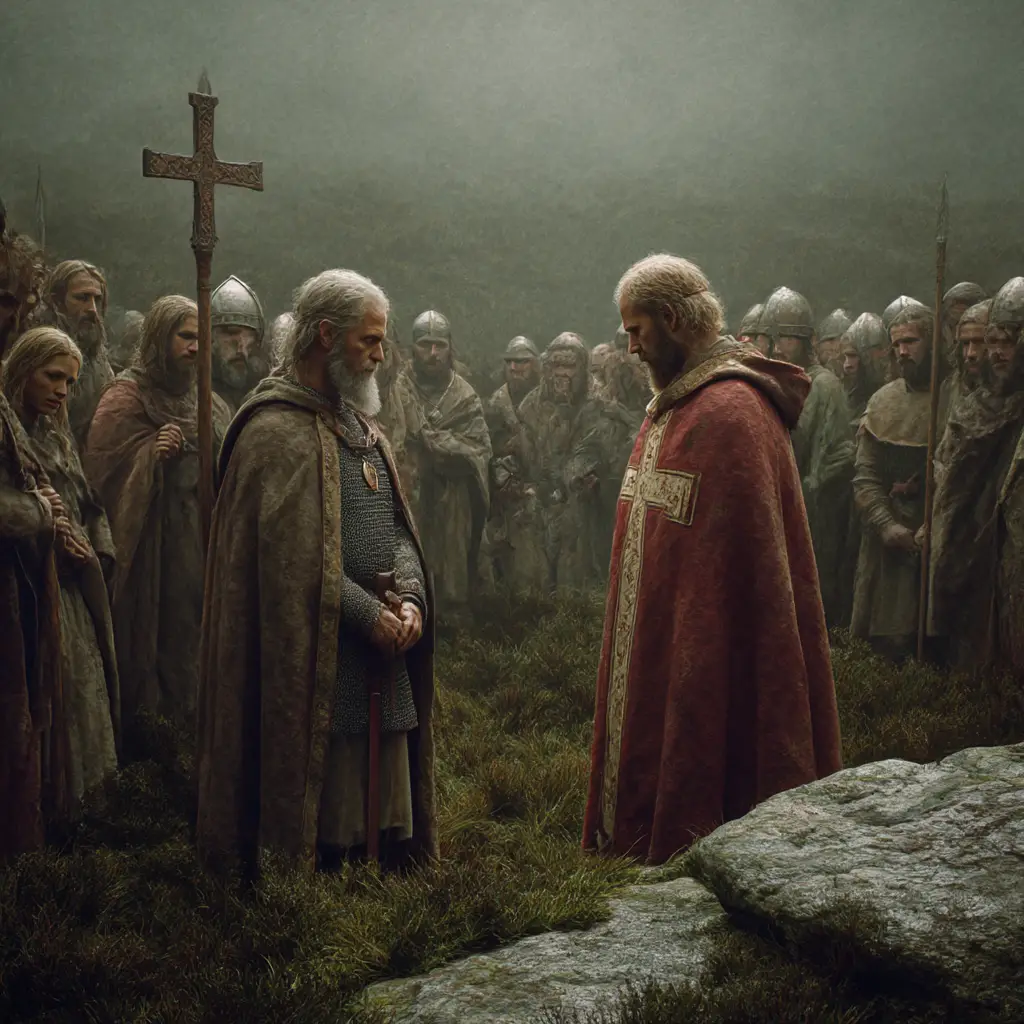
When Sigurd travelled to Norway, Olaf confronted him directly. The saga describes how the king demanded that Sigurd accept baptism and ensure that Christianity was adopted throughout Orkney. Sigurd initially resisted, but Olaf applied pressure by taking Sigurd’s son as a hostage. Faced with the threat to his family and his political position, Sigurd agreed to be baptised and to enforce the new religion in his earldom. The conversion is therefore shown as compulsory, driven by royal power rather than persuasion.
After Sigurd’s return to Orkney, Christianity was formally introduced. The saga suggests that the change was swift and authoritative, with resistance either minimal or unrecorded. Churches were established, Christian practices were imposed, and the old religious customs were set aside. The lack of detailed description of local opposition implies that the authority of the earl was sufficient to carry out the change, even if acceptance among the population may have been uneven at first.
The saga later connects this conversion to the growing organisation of the Church in Orkney. Over time, the islands developed a recognised ecclesiastical structure, including bishops and church centres, which tied Orkney more closely to both Norway and the wider Christian world. Christianity became part of everyday governance and law, reinforcing the authority of the earls and aligning the islands with European norms of rule.
Overall, the Orkneyinga Saga presents the conversion to Christianity as a decisive moment imposed from above, shaped by political loyalty and royal pressure. It reflects how religion, power, and allegiance were closely linked in the Norse world, and how Orkney’s place between Scandinavia and the British Isles influenced the way this change unfolded.