The Orkneyinga Saga provides one of the fullest narrative accounts of medieval Orkney, blending history, memory, and storytelling. Among its most substantial episodes are the rule of Rognvald Kali Kolsson and the building of St Magnus Cathedral at Kirkwall. These sections describe a period of consolidation, ambition, and political change in the twelfth-century earldom, set against the wider Norse world of Norway, the Scottish mainland, and the North Atlantic.
Rognvald Kali Kolsson enters the saga as a man of distinguished lineage and careful preparation. He was the son of Kol Kalason, a Norwegian nobleman, and Gunnhild, sister of Earl Magnus Erlendsson of Orkney. This connection to Magnus proved decisive. When King Sigurd of Norway granted Rognvald the title of earl, it was explicitly tied to his maternal inheritance. The saga emphasises that Rognvald did not simply receive power; he had to claim it. Orkney at this time was divided between rival earls, most notably Harald Maddadsson, and the islands were accustomed to shared and often unstable rule.
Rognvald’s arrival in Orkney marked the beginning of a prolonged struggle for authority. The saga describes alliances, skirmishes, and negotiations rather than continuous warfare, reflecting the political reality of the time. Power depended on kinship networks, support from Norway, and the loyalty of local chieftains. Rognvald is presented as a capable organiser and a leader who understood the need to balance force with diplomacy. His reign was not uncontested, but it was persistent, and over time he established himself as a central figure in the earldom.
One of the most significant acts attributed to Rognvald was his vow to build a great stone church at Kirkwall in honour of his uncle, Magnus Erlendsson, who had been killed during a dispute with his cousin, Earl Håkon. According to the saga, Magnus was widely regarded as a man of exceptional character, and stories of his conduct and death circulated long after his burial. Rognvald promised that if he secured his position as earl, he would build a cathedral worthy of Magnus’s reputation.
The saga describes the practical challenges of fulfilling this vow. Building in stone on the scale proposed required resources, labour, and organisation beyond anything previously attempted in Orkney. To raise the necessary funds, Rognvald imposed a levy on the islands, demanding a contribution from landowners. Resistance is mentioned, but the project went ahead, indicating that Rognvald was able to enforce his authority while keeping opposition contained. This episode highlights the administrative side of his rule, showing an earl who could translate political power into long-term projects.
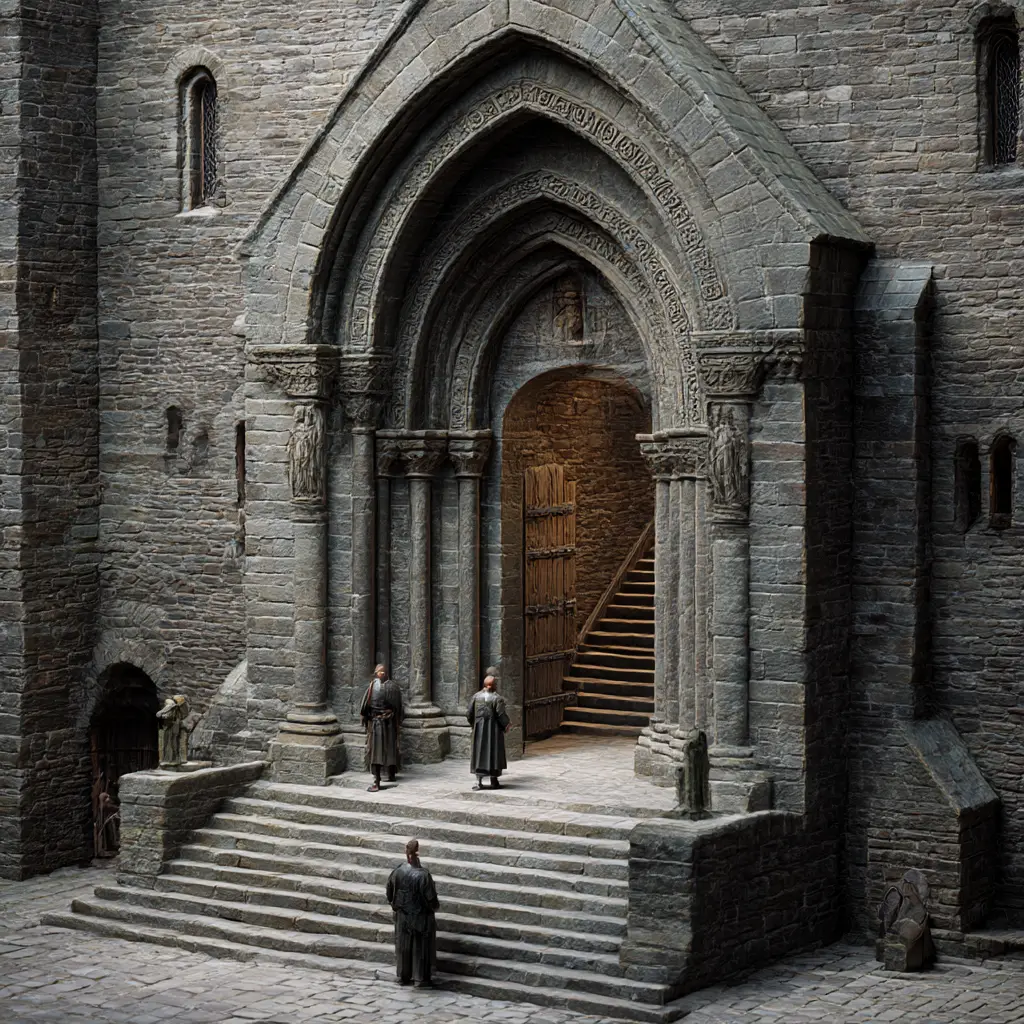
Construction of St Magnus Cathedral began around the middle of the twelfth century. The saga does not dwell on architectural detail, but it makes clear that the building was intended to be monumental. Stone was brought from local sources, and skilled craftsmen were required, likely influenced by styles from Norway and northern Britain. Kirkwall’s position as a trading and administrative centre made it the natural location, and the cathedral anchored the town’s growing importance within the earldom.
Rognvald’s rule extended beyond Orkney itself. The saga recounts his involvement in expeditions, feuds, and a journey to the eastern Mediterranean, where he travelled with other Norse nobles. These episodes serve to place Orkney within a broader Norse aristocratic culture, one that valued travel, reputation, and participation in events far beyond local waters. Rognvald is portrayed as cultured as well as martial, a poet as well as a warrior, which distinguishes him from many earlier saga earls.
Despite periods of relative stability, his later years were marked by renewed conflict. Rivalries resurfaced, and shifting alliances eventually led to his death while travelling through Caithness. The saga records his killing as the result of betrayal, a reminder that authority in the Norse world was always precarious, no matter how established a ruler might appear.
The sections of the Orkneyinga Saga dealing with Rognvald Kali Kolsson and the building of St Magnus Cathedral together present a detailed picture of twelfth-century Orkney. They show an earldom shaped by family ties, obligations to the Norwegian crown, and the constant negotiation between force and legitimacy. Through these accounts, the saga preserves a record of how power was exercised, challenged, and made visible in one of the most important periods of Orcadian history.