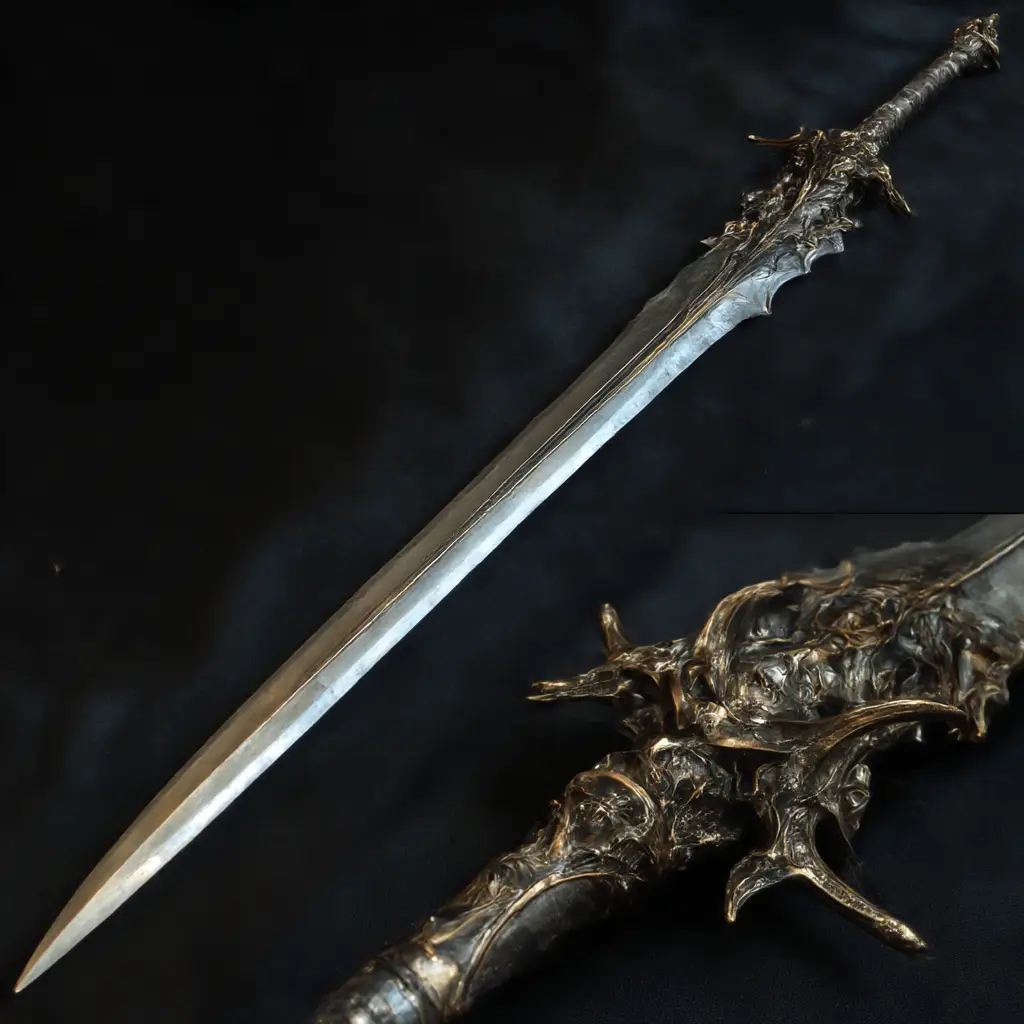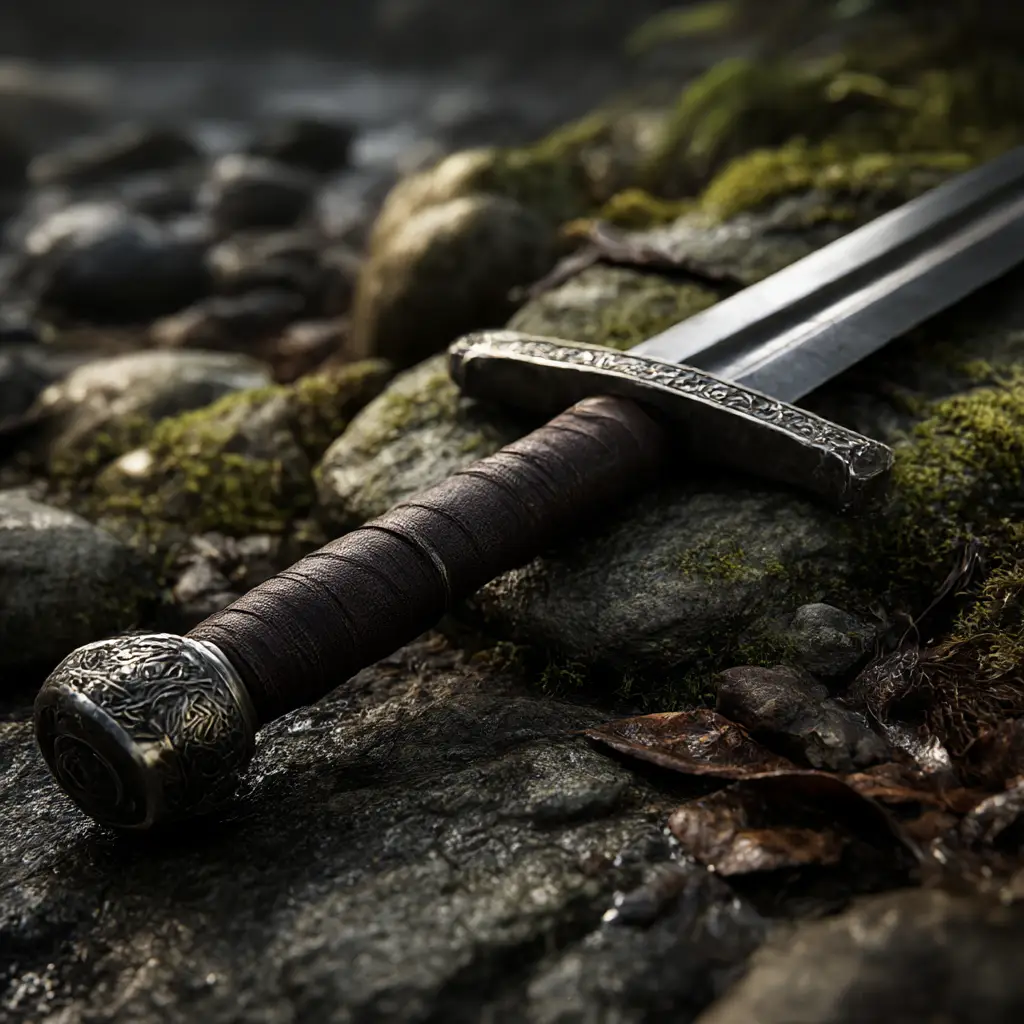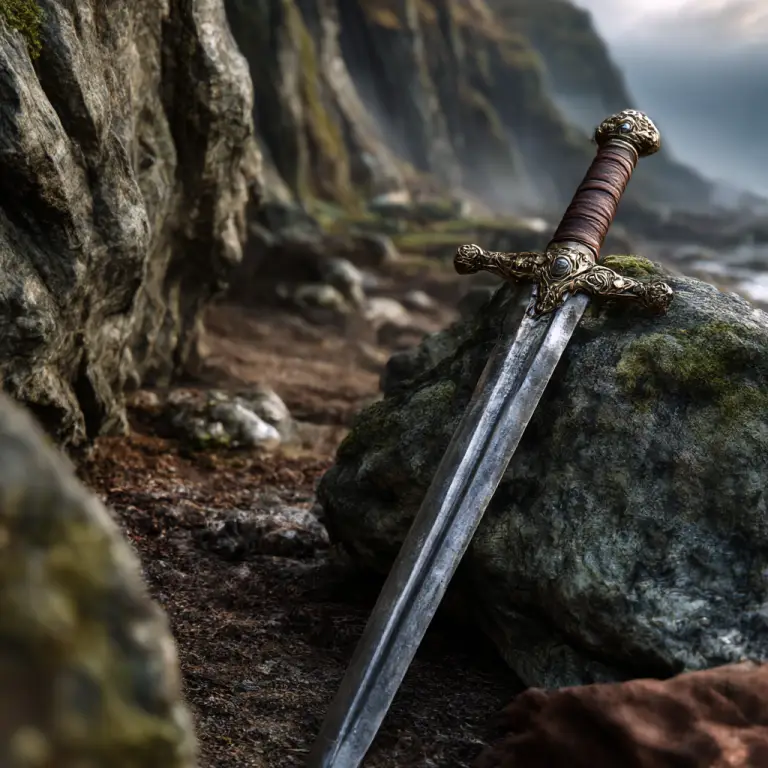
The sword Gram stands among the most famous weapons in Norse legend, bound to the heroic line of the Völsungs and woven through one of the great narrative cycles of the North. It is not merely a weapon but a symbol of destiny, kingship, and the idea that only the worthy can wield true power.
Origins of Gram
Gram first appears in the Völsunga saga, where it is introduced in a moment charged with mystery and authority. During a feast held by King Völsung, a one-eyed stranger—widely understood to be the god Odin in disguise—enters the hall and drives a sword deep into the trunk of a great tree that grows through the centre of the building. He declares that whoever can pull the sword free may keep it.
Many try and fail. Only Sigmund, the king’s son, succeeds. This act marks him as chosen, and Gram becomes his blade. The scene establishes a recurring idea in Norse myth: fate reveals itself through deeds rather than words.
Gram and Sigmund
Sigmund wields Gram in numerous battles, and the sword becomes closely tied to his reputation as a formidable warrior. However, its story is not one of uninterrupted triumph.
In a later battle, Sigmund faces overwhelming odds. During the fight, the same mysterious figure—again understood to be Odin—reappears. This time, he intervenes against Sigmund, shattering Gram with a single strike. The breaking of the sword signals that Sigmund’s fate has turned; even the greatest heroes cannot stand against destiny when it shifts.
Sigmund dies soon after, but the fragments of Gram are preserved, setting the stage for the next chapter of its story.
The Reforging of Gram
The broken pieces of the sword pass to Sigmund’s son, Sigurd, one of the most celebrated heroes in Norse legend. Raised by the smith Regin, Sigurd is eventually given the fragments of his father’s blade.
Regin reforges Gram, restoring it to its former strength—if not surpassing it. The reforged sword is described as exceptionally sharp and powerful, capable of cutting through an anvil or slicing a strand of wool drifting in water. These exaggerated details are typical of heroic literature, but they underline the idea that Gram is no ordinary weapon.
The Slaying of Fafnir
Gram’s most famous deed comes when Sigurd uses it to kill the dragon Fafnir. Acting on Regin’s advice, Sigurd digs a trench along the path where the dragon crawls to drink. As Fafnir passes overhead, Sigurd thrusts Gram upward into the creature’s underside, delivering a fatal blow.
This moment is central to the legend. The sword, reforged from fragments and tied to a heroic lineage, becomes the instrument through which a seemingly invincible creature is brought down. The act transforms Sigurd into a legendary figure and cements Gram’s place in myth.
Symbolism and Meaning
Gram is more than a tool of war. It carries several layers of meaning:
- Divine authority – Its origin links it directly to Odin, suggesting that its power is sanctioned by the gods.
- Fate and inevitability – The sword’s breaking and reforging mirror the rise and fall of heroes across generations.
- Inheritance and legacy – Passed from father to son, Gram represents continuity, memory, and the burden of expectation.
The idea that a weapon can embody both glory and tragedy is central to Norse storytelling. Power is never free of consequence.