Ahmad ibn Fadlan’s account is one of the most detailed contemporary descriptions of Norse funerary practice to survive, even though it comes from an outsider rather than from Norse tradition itself. Writing in the early tenth century, ibn Fadlan was an Arab diplomat and scholar who encountered a group of Norse traders, often identified as Rus, along the Volga River. His record includes a vivid eyewitness description of the funeral of a high-status man and the ritual killing of a slave girl who was sent with him in death.
According to ibn Fadlan, the dead man was placed temporarily in a grave while preparations were made for an elaborate ceremony. His people asked who among his slave women would choose to die with him. One young woman volunteered, and once she had done so, there was no turning back. From that moment, she was closely watched and attended by other women. Ibn Fadlan notes that she drank heavily and appeared cheerful, moving from tent to tent and bidding farewell to the people she knew.
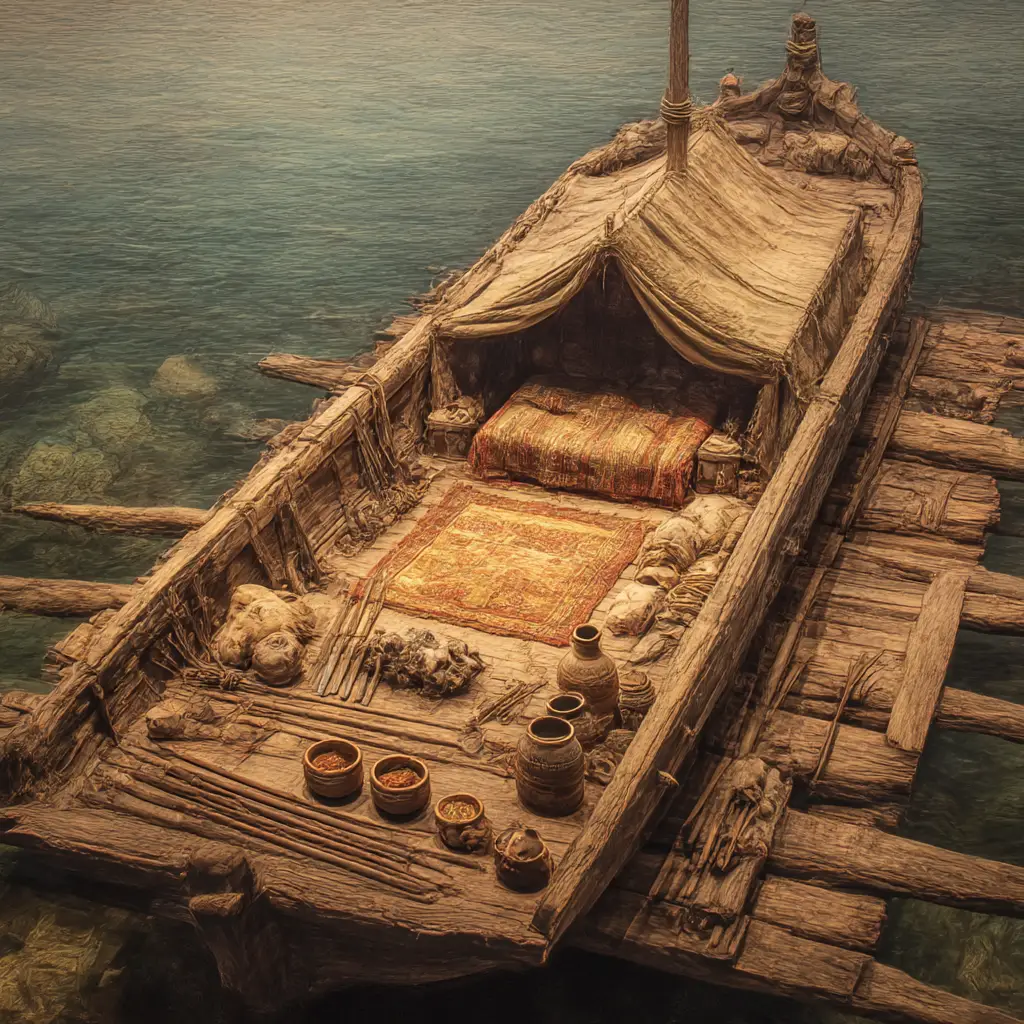
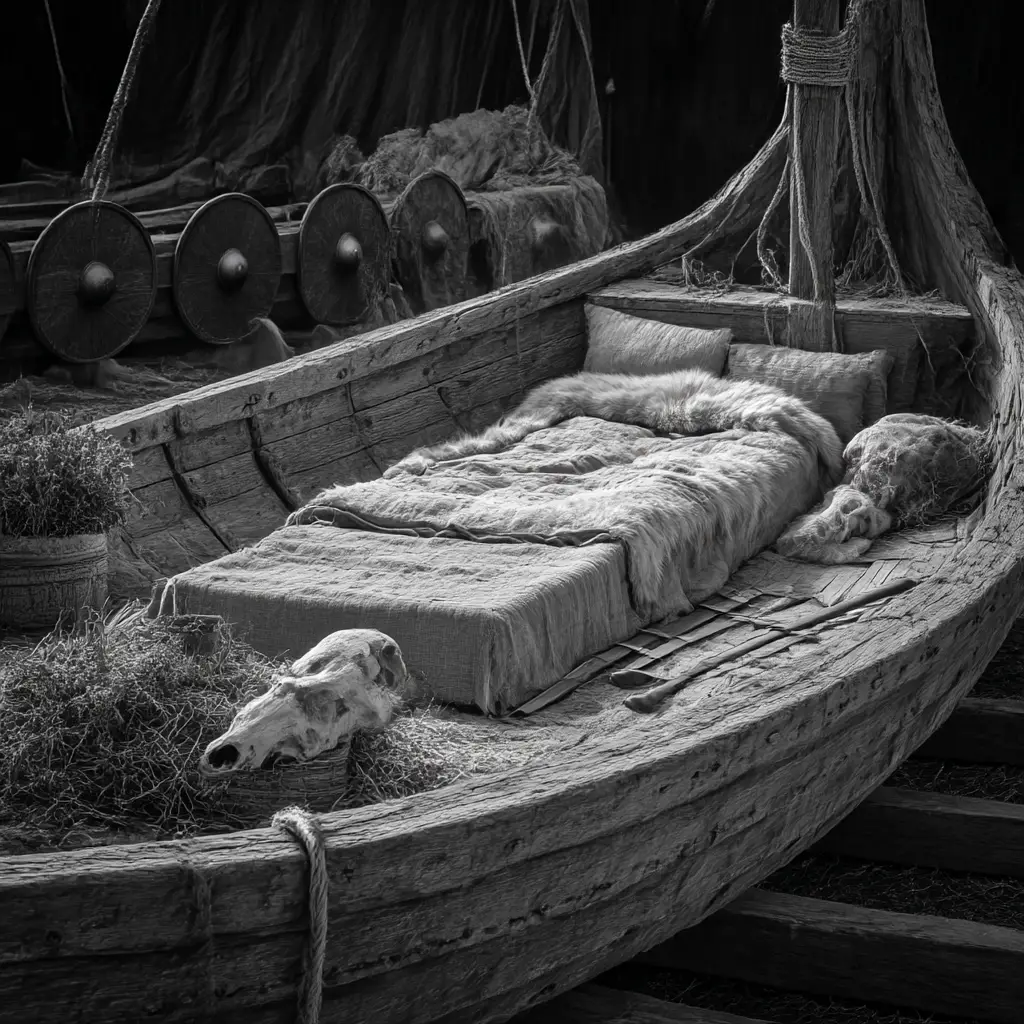
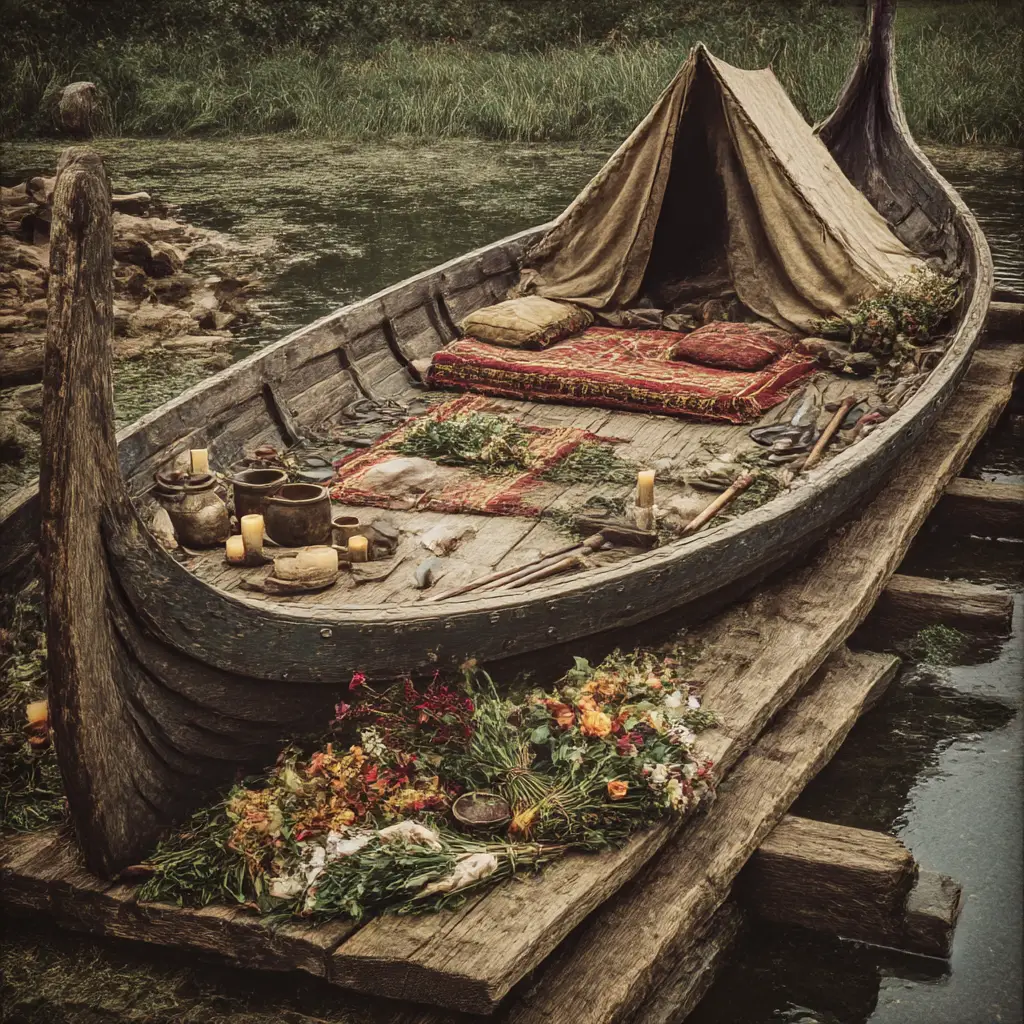
The funeral took place on a ship that had been hauled onto land. The vessel was arranged as a kind of platform, with wooden supports beneath it. On board, a structure resembling a tent or small chamber was erected, furnished with cushions and fine textiles. The dead man was washed, dressed in rich clothing, and seated inside this structure. Around him were placed weapons, food, drink, and various goods. Animals were sacrificed, including dogs, horses, and cattle, and their bodies were added to the ship.
The slave girl was then brought to the vessel.
In Ahmad ibn Fadlan’s account, the slave girl is lifted three times, and each time she reports seeing something different.
As he describes it, she is raised above a structure that he compares to a doorframe or wooden frame. After each lifting, she speaks to those around her about what she sees.
The first time, she says she sees her father and mother. The second time, she says she sees her deceased relatives seated together. The third time, she says she sees her master sitting in a green, lush place, accompanied by men and boys, and that he is calling for her to come to him.
Before her death, the slave girl was led into the tent on the ship. Several men entered with her. Ibn Fadlan reports that they struck their shields loudly so that her cries would not be heard. Inside, she was killed by the ritual leader with a knife, while others assisted. The description is direct and unsettling, focused on the physical actions rather than any explanation of their deeper meaning.
Once the girl was dead, her body was placed beside that of her master within the tent. The structure was then closed. Wood was piled beneath and around the ship, and a fire was set. Ibn Fadlan describes the flames taking hold quickly, consuming the ship, the bodies, the animals, and all the grave goods. When the fire had burned out, a mound was raised on the spot, and a wooden post was erected, carved with the name of the dead man and that of their king.
Although this account is often discussed alongside Norse mythology, it is important to note that ibn Fadlan was recording what he saw among a specific group at a particular time. His narrative does not come from myth or legend but from observation. Nevertheless, it has become a key source for understanding how death and burial could be handled in Norse society, especially for individuals of high rank.
The sacrifice of the slave girl is described without embellishment. Ibn Fadlan does not frame it as a story or moral lesson, nor does he attempt to justify or condemn it in detail. His tone is that of a careful observer, noting customs that were strange and disturbing to him. This makes the account especially valuable as historical evidence, as it shows the ritual as it was performed, rather than as it was remembered or retold later.