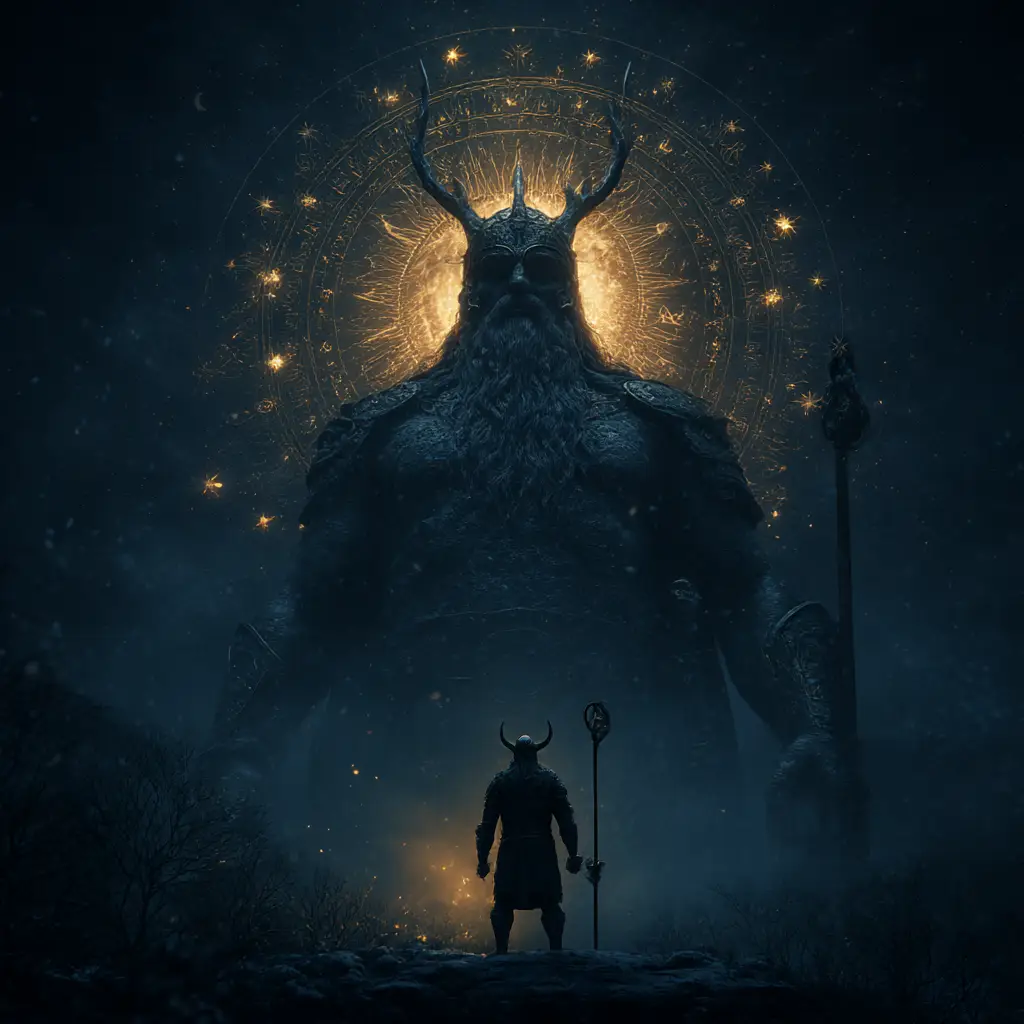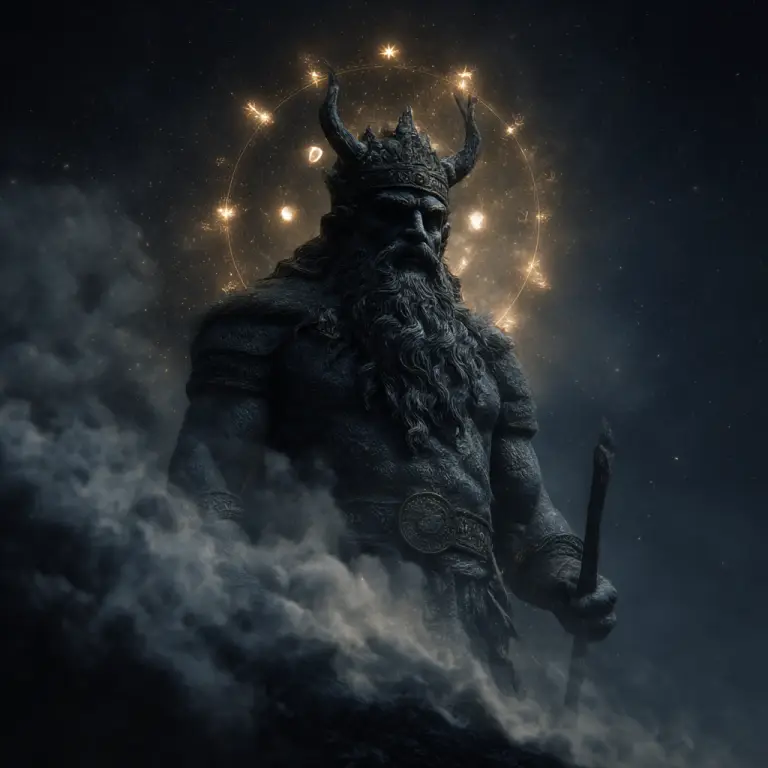
Mundilfari is a figure from Norse mythology best known as the father of the celestial siblings who govern time and the sky. Although he appears only briefly in the surviving sources, his role is central to the mythic explanation of day, night, and the movement of heavenly bodies. The name Mundilfari is generally understood to relate to the turning or rotation of time, suggesting a being associated with cosmic cycles.
In the Poetic Edda and the Prose Edda, Mundilfari is described as the father of Máni, the personification of the Moon, and Sól, the personification of the Sun. According to the myth, the gods took offence at the names he gave his children, considering them overly proud. As a consequence, the gods placed Máni and Sól in the sky and tasked them with guiding the Moon and the Sun across the heavens. Their movement became the rhythm by which the world measures days and nights, months and seasons.
Sól drives the sun’s chariot, pulled by two horses, while a wolf chases her across the sky. Máni guides the moon’s path and is pursued by another wolf. This chase explains the continual passing of time and the phases of the Moon. Although Mundilfari himself does not receive a detailed story or characterisation, his position as the parent of these celestial forces places him close to the underlying order of the cosmos.
Some scholars interpret Mundilfari as a personification of time or as a mythic ancestor representing the cyclical motion of the heavens. Others view him simply as an origin figure included to give lineage to deities with important cosmic duties. The sparse nature of the surviving texts leaves much about him open to interpretation, and this has allowed later writers and researchers to speculate on his wider symbolic meaning.
In modern retellings and adaptations of Norse mythology, Mundilfari is sometimes portrayed as a keeper of cosmic order or a wise figure with knowledge of the movements of the sky. While these interpretations are not explicitly supported by the early sources, they highlight the enduring fascination with the small but significant role he plays in the mythological structure of the Norse cosmos.