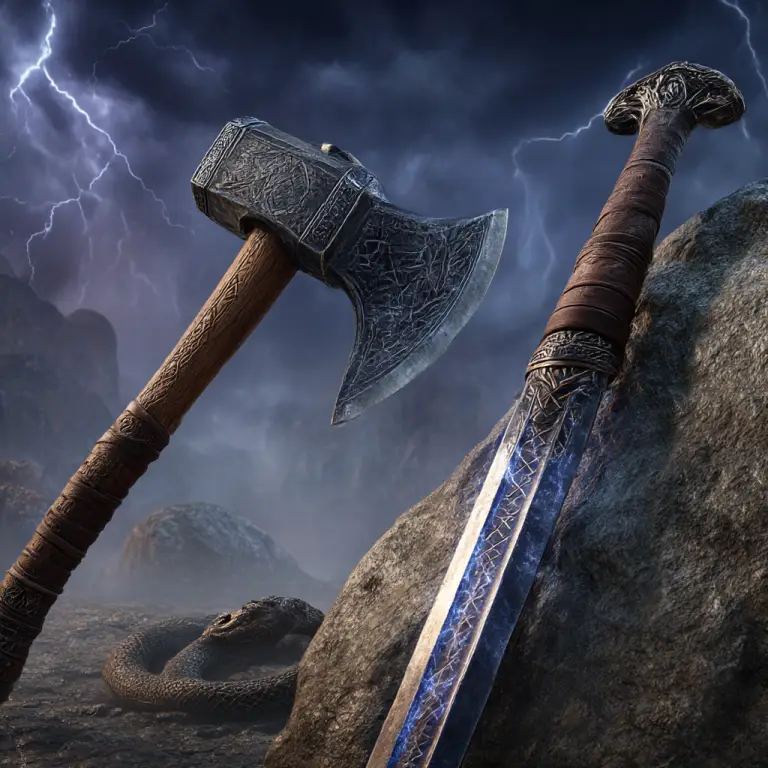
The world of Norse mythology is filled with weapons that are far more than tools of war. These objects carry identity, status, and often a will of their own. Forged by master craftsmen, gifted by gods, or won through trials, legendary weapons in Norse tradition are bound to fate as much as to the warriors who wield them. Their stories reveal how the Norse viewed power, honour, and the often-blurred line between human skill and divine influence.
The Nature of Legendary Weapons
In Norse belief, a weapon was never just an object. It could embody luck, lineage, or even a fragment of the supernatural. Swords, spears, and hammers were frequently named, and naming mattered. A named weapon had history, and with history came expectation. To inherit such a weapon was to inherit responsibility, and often a destiny that could not easily be avoided.
Many of these weapons were said to be forged by dwarves, master smiths who appear throughout Norse mythology as unparalleled craftsmen. Their creations were precise, powerful, and sometimes dangerous even to their owners. These weapons did not simply enhance a warrior’s strength; they defined it.
Mjölnir – The Hammer of Thor
Mjölnir, the hammer wielded by the god Thor, is perhaps the most recognisable weapon in Norse mythology. It was forged by dwarven brothers and is associated with protection, consecration, and raw destructive force. Despite its relatively short handle, it was perfectly balanced and always returned to Thor’s hand after being thrown.
Mjölnir was used not only to defeat giants but also to bless marriages and sanctify important events. This dual purpose reflects a key aspect of Norse belief: the same force that destroys can also protect and preserve order.
Gungnir – Odin’s Spear
Gungnir, the spear of Odin, was another dwarven creation, renowned for its perfect aim. Once thrown, it would never miss its target. More than a weapon, it symbolised authority and divine power. Odin himself would cast Gungnir over enemy forces to dedicate them to battle, a ritual act that carried both psychological and spiritual weight.
The spear also connects to Odin’s role as a seeker of knowledge. In myth, he sacrifices himself by hanging from the world tree, pierced by a spear, in a quest for wisdom. Gungnir therefore represents not just warfare, but sacrifice and the pursuit of deeper understanding.
Gram – The Sword of Heroes
Gram is the legendary sword associated with the hero Sigurd. It is a weapon of exceptional sharpness and strength, capable of cutting through an anvil. Its story is one of destruction and renewal: the sword is broken, reforged, and then used to slay the dragon Fafnir.
This cycle reflects a recurring theme in Norse storytelling. Power is rarely permanent. It must be lost, remade, and proven again. Gram is not simply a sword; it is a test of worthiness. Only a true hero can wield it to its full potential.
Tyrfing – The Cursed Blade
Not all legendary weapons bring honour. Tyrfing is a sword forged by dwarves under compulsion, and it carries a curse. It must kill whenever it is drawn, and it brings tragedy to its owners. Though it never rusts and can cut through anything, its power comes at a cost.
Tyrfing illustrates a darker truth in Norse mythology. Strength without control leads to ruin. A weapon may grant victory in battle, but it can also destroy the life of the one who depends on it.
Skofnung – The King’s Sword
Skofnung is a legendary sword tied to Danish kings, known for its sharpness and supernatural qualities. It was said to carry the spirits of its former owners, and strict rules governed its use. It could not be drawn in the presence of women, and sunlight diminished its power.
These restrictions reinforce the idea that legendary weapons existed within a framework of ritual and respect. They were not to be used casually. Breaking the rules surrounding them often led to misfortune.