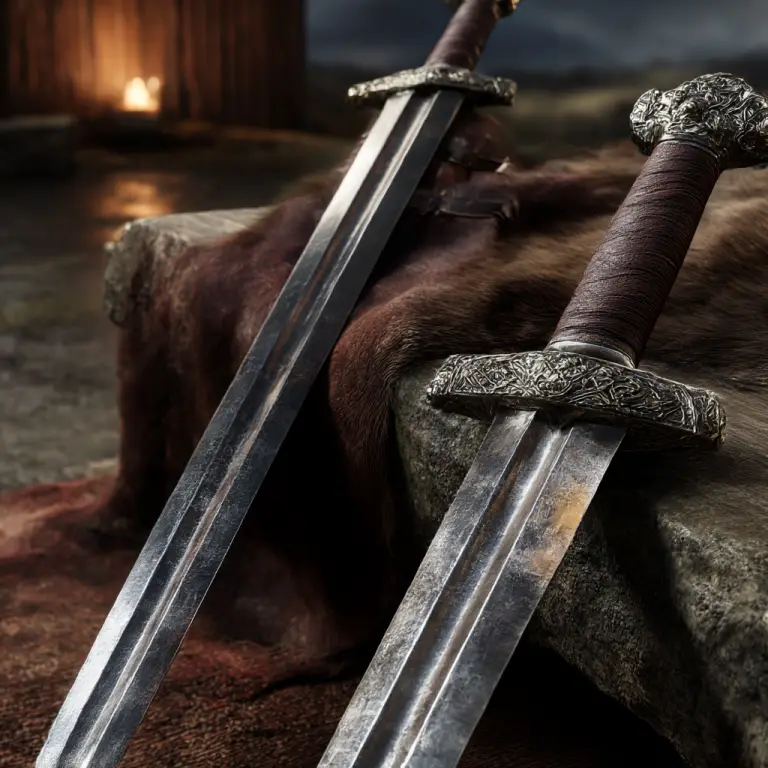
Skofnung is one of the most renowned legendary swords in Norse tradition, often described as the finest blade ever carried in the northern world. Its reputation is bound not only to its craftsmanship, but to the aura of mystery and power that surrounds it. Unlike many weapons of myth that are clearly tied to the gods, Skofnung occupies a more grounded yet no less fascinating place, linked to kingship, honour, and the enduring weight of legacy.
The sword is most closely associated with the Danish king Hrólf Kraki, a semi-legendary ruler whose court appears in several Old Norse sources. Skofnung was said to have been his personal weapon, forged with exceptional skill and imbued with qualities that set it apart from ordinary blades. It was renowned for its sharpness and balance, capable of cutting through armour with ease, and for never failing its wielder in battle.
What makes Skofnung particularly intriguing is the belief that it possessed a kind of presence or spirit. In the sagas, it is said that the sword would emit a distinctive sound when drawn, almost as if it were aware of its purpose. This idea reflects a broader Norse worldview in which objects, especially weapons, could carry something of their owner’s essence. A sword was not merely a tool but an extension of the warrior, shaped by reputation and deeds as much as by metal and fire.
After the death of Hrólf Kraki, Skofnung did not simply vanish into legend. According to the sagas, it was buried with him, along with his warriors, in a great barrow. This act reinforced the bond between king and weapon, suggesting that the sword’s story was inseparable from the man who wielded it. Yet, as with many Norse tales, the boundary between rest and rediscovery is thin. The sword was later retrieved from the burial mound by the Icelandic hero Skeggi of Midfjörður, bringing it back into the world of the living.
The sagas place strict conditions on the use of Skofnung. It was said that the sword should not be drawn in the presence of women, nor exposed to sunlight unnecessarily. These restrictions hint at ritual or superstition, perhaps a way of emphasising the weapon’s sacred or dangerous nature. There is also mention of a special stone used alongside the sword to heal wounds it inflicted, adding another layer to its mythic qualities. The blade could harm with unmatched precision, but it also carried within its story the means of restoration.
In a cultural sense, Skofnung reflects the values of the Viking Age. It embodies the importance of reputation, the connection between a leader and his followers, and the idea that power must be respected and carefully handled. Weapons like Skofnung were symbols of authority as much as instruments of war. To possess such a blade was to carry the weight of those who had held it before, along with the expectations that came with it.
Although no physical trace of Skofnung exists today, its story endures through the Icelandic sagas and the wider body of Norse literature. It stands as a reminder of how the Norse people understood the relationship between objects and identity. In their world, a sword could be more than forged steel. It could be memory, status, and myth combined into a single, enduring form.