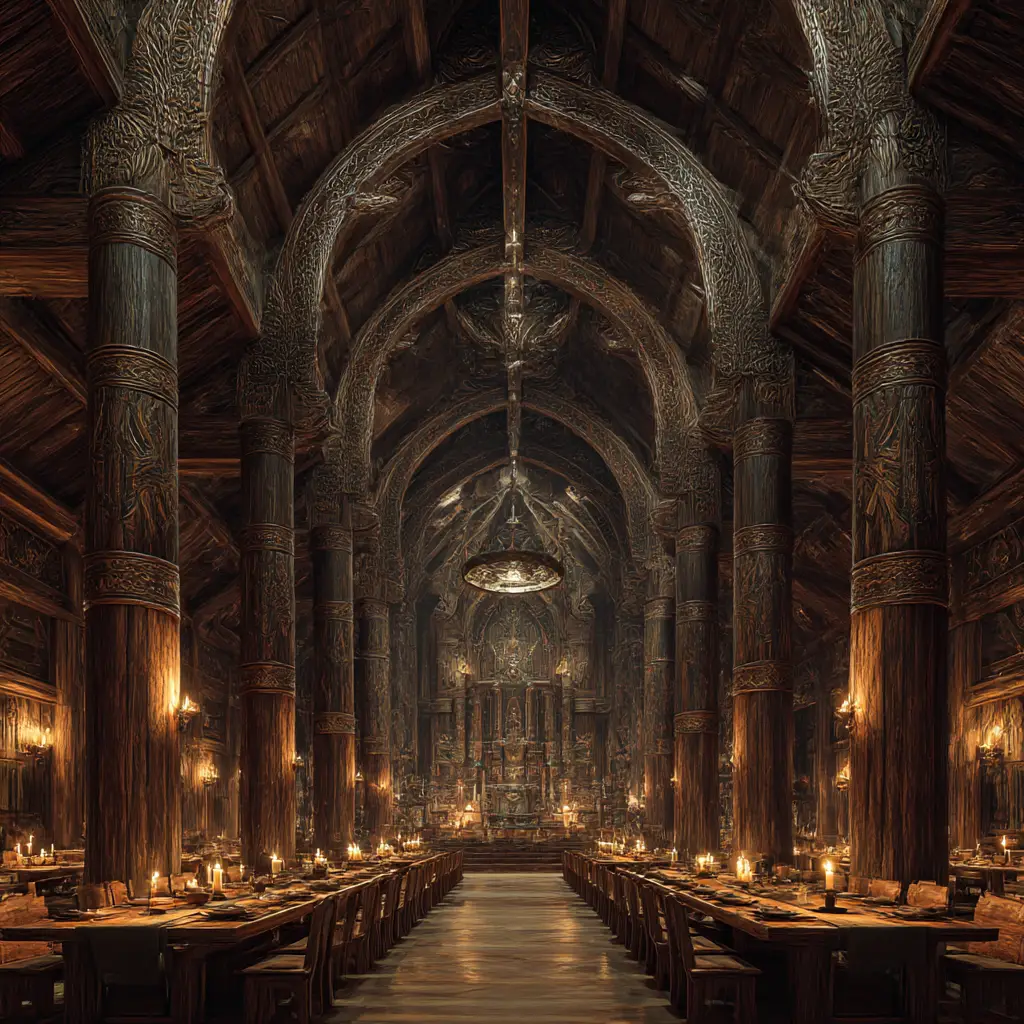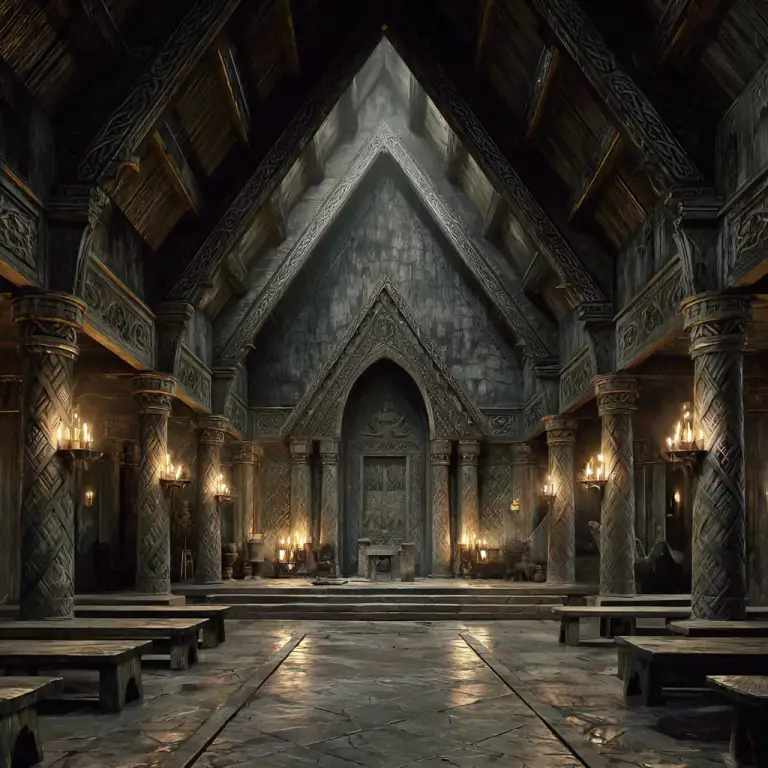
Bilskirnir is the great hall of the god Thor in Norse mythology and is described as one of the largest and most impressive dwellings in the mythological cosmos. It is located in Ásgarðr, the realm of the Æsir gods, and is said to stand within the region known as Þrúðvangr, which is Thor’s domain.
According to the Poetic Edda and the Prose Edda, Bilskirnir is remarkable for its immense size. It is described as having five hundred and forty rooms, making it larger than any other hall mentioned in the surviving sources. This vast scale reflects Thor’s prominence among the gods and the importance of his household within Ásgarðr. The hall serves as Thor’s main residence, where he lives with his wife Sif and their children.
Bilskirnir functions as both a home and a place of activity. As Thor is frequently portrayed travelling across the worlds to confront giants and other threats, the hall is a fixed point to which he returns after his journeys. It is within Bilskirnir that Thor rests, feasts, and receives guests when he is not abroad. The hall is also associated with the daily life of the god, including family matters and the maintenance of his estate.
The sources do not give a detailed physical description of Bilskirnir’s construction, but as a hall in Ásgarðr it would be imagined as a grand and sturdy structure, fitting for a god known for strength and endurance. Like other divine halls in Norse myth, it would have been understood as a place of warmth, order, and hospitality, contrasting with the often hostile landscapes beyond the gods’ realm.
Bilskirnir is mentioned alongside other famous halls such as Valhöll, Odin’s hall, and Fólkvangr, associated with the goddess Freyja. Its inclusion among these well-known dwellings highlights its importance in the mythological geography of the Norse world. While Thor is often characterised by action and movement, Bilskirnir represents the settled aspect of his existence, anchoring him within Ásgarðr and providing a setting for his role as a member of the divine community.
Although references to Bilskirnir are relatively brief compared to accounts of Thor’s deeds, the hall remains a significant element of Norse myth. Its sheer size and placement in the realm of the gods mark it as a central feature of Thor’s presence in the mythological tradition, offering insight into how medieval Scandinavian audiences imagined the homes and lives of their gods.